
A Clear Look at Ventnor’s 2026 Budget
Published on June 17, 2026
As discussions ensue on the 2026 municipal budget, it helps to step back from the complex spreadsheets and look at the bigger picture of where our tax dollars go and how they are managed. Looking at our financial history through a regular lens—rather than a political or highly technical one—reveals that balancing a town's budget is all about making smart choices for both the short term and the long haul.
Your Tax Bill: Who Controls What, and Where Does the Money Go?
When you look at your annual property tax bill, the total amount is split among three separate entities, each with its own level of local control and responsibility:
- The School Share (28%): This portion goes directly to funding the school district and is managed by the school board on an approval basis and voted on by the City and representatives of the school board. Over the years, the city administration has actively partnered with the school board to strategically space out large, expensive building and capital projects over time, so they do not hit property owners all at once.
- The County Share (26%): This portion goes to the county government and is entirely outside of our local city administration's control.
- The Municipal Share (46%): The city itself receives less than half of your total tax payment to run all local municipal service residents rely on each day—from public safety and public works to trash collection and code enforcement. This is the portion the city administration oversees line by line.
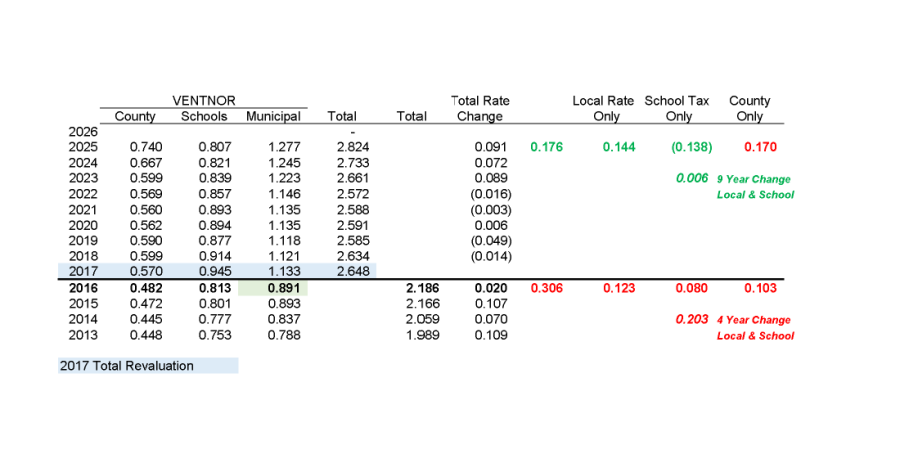
When you look at the historical data in TAX RATES 2013-2025 this careful coordination shows clear results. If you combine the local city tax and the school tax together, the rate rose by just .006, which is a little over ½ of a cent, over a nine-year period from 2017 to 2025. To put that into perspective, the previous administration saw the combined local and school rate jump by 0.306, which is just over 30 cents, in just four years from 2013 to 2016—a much higher increase in less than half the time.
During this recent period of stable tax rates, Ventnor has also seen major physical improvements that residents can see with their own eyes: property values have risen, the city has secured significant grant funding, and major investments have gone into upgrading our parks, roads, flood protection, and rebuilding the boardwalk.
Maximizing Outside Grants to Protect Local Taxpayers
A major reason the city has been able to maintain this long-term tax stability while heavily upgrading the town is its aggressive pursuit of outside funding. By securing state and federal grants, Ventnor successfully shifts the financial burden of massive infrastructure projects away from local property owners.
According to an official grant summary of March 16, 2026, compiled by Rutala Associates, the city’s proactive strategy has brought in over 90 million dollars for essential improvements:
- Major Infrastructure & Coastal Protection: This includes a massive $7.1 million state grant for the boardwalk reconstruction project, over $1.6 million for bulkheads along Winchester Avenue, and a $5.9 million federal grant currently under review for the Lower Ventnor Heights Flood Mitigation Project.
- Roadways & Streetscapes: The town has locked in nearly $960,000 for the Dorset Avenue streetscape project, alongside consecutive annual state transportation grants for the reconstruction of Suffolk, Wellington, and Ventnor Avenues.
- Unavoidable Water & Sewer Mandates: The state requires towns to replace aging lead and galvanized water service lines. To tackle this $65 million mandate without crushing local taxpayers, the city has tapped into specialized funding programs. This includes a $60 million application for the lead lines, alongside $3.05 million for sewer lines and over $1.1 million for the Surrey Avenue water tower—utilizing structural incentives like "principal forgiveness" (essentially free grant money) and interest-free loans to complete the work safely and affordably.
The Strategy Behind the Operational Reserve Fund
Another major piece of the budget puzzle is how the city manages its "fund balance," which acts as the town's operational reserve or financial safety net.
According to the records for the City’s Fund Balance History the city has followed a very logical pattern. As the town grew and the reserve fund got larger, the administration steadily increased the amount of reserves it used each year to help pay for the annual budget and keep tax increases down.
Why this approach makes sense for a town:
A city is not exactly like a household, and it isn't a business meant to make a profit. However, it cannot run without a solid financial cushion. The city must make payroll every two weeks, pay its vendors on time, handle unexpected emergencies, and absorb delays when state aid is late.
Furthermore, the city must deal with massive, unavoidable future costs—like rising insurance premiums, pension obligations, and large-scale utility mandates.
Because of this, using a piece of our reserves every year to help offset taxes is wise, but draining too much at once is risky. If the city uses too much of its cushion this year to lower your current tax bill by a few cents, it means starting next year with an empty pocket. That doesn't make the city's costs go away; it just pushes the bill onto next year's taxpayers.
Ultimately, the goal of the budget isn't just about cutting a corner for a quick, short-term fix. It is about making sure that while we keep today's tax burden as manageable as possible, we also keep Ventnor financially strong, physically improved, and ready for whatever challenges come tomorrow.
The two charts prepared by the City Auditor provide important context for these budget discussions.
The chart below shows the City, School, and County tax rates and how they have changed over time. Since this administration’s first budget in 2017, the combined City and School tax rate has increased by just over one-half of a penny (.006) over nine years. The chart also reflects the disciplined financial planning that has allowed needed investments to be made while limiting the impact on taxpayers.
The chart below tracks the City’s fund balance from 2015 through 2025. It shows that the City has increasingly relied on fund balance to help support annual budgets and reduce the tax burden. However, fund balance is not an unlimited resource. It serves as the City’s financial cushion for cash flow needs, emergencies, and rising future costs. Using some of it each year can help offset taxes, but using too much simply shifts today’s costs into future budgets. The goal is to provide tax relief while maintaining the long-term financial stability of the City.
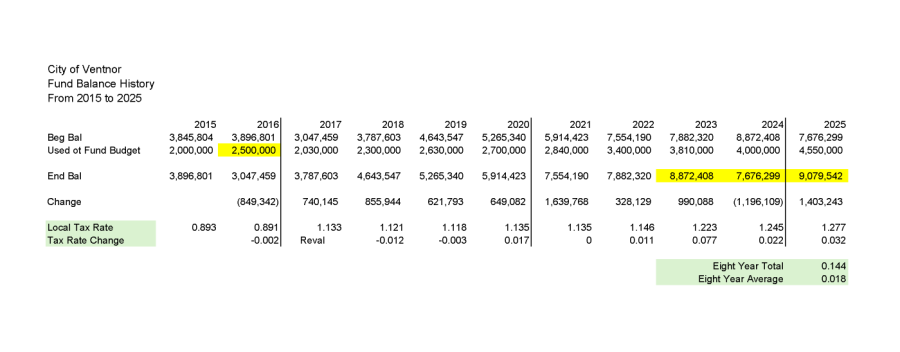
Again, it is important to note that this administration's first budget was in 2017. Prior decisions regarding the use of surplus were made before we took office. Since day one, our position has been consistent: fund balance is a financial safety net, not a recurring revenue source. While spending down reserves may make a budget look better in the short term, it does not create long-term financial strength. Our focus has always been on building a stronger Ventnor, maintaining healthy reserves, and ensuring the City is prepared not just for next year, but for the years ahead.